
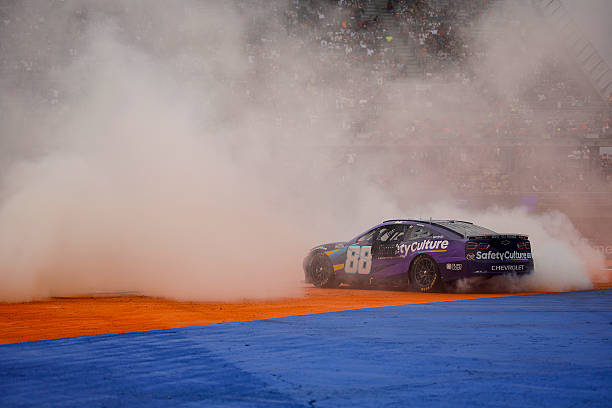
As expected prior to the start of the 2025 season, Shane van Gisbergen won a road course race this past weekend to secure his spot into the playoffs. Similar to how he won in his debut race, van Gisbergen put on a strong showing throughout the entire weekend. Plus, the race on a new track for the Cup Series even featured wet conditions. None of this comes as a surprise. What might have been a bit surprising is where Shane van Gisbergen sat in points heading into Mexico City. While no one considered van Gisbergen a threat to break into the Top-20, how many thought he would be 33rd and miss the in-season tournament entering this race? Now, that does not matter anymore because SVG is playoff bound and will compete for the championship. With that returns the usual talking points of the NASCAR’s playoff format.

Photo by Chris Graythen/Getty Images
Once again, this pesky playoff system plays spoiler to what should be a cool moment. Sure, predicting Shane van Gisbergen to win Mexico City might have been an “easy call”. However, it is only his second career win after going winless on road courses last year. Even for a road course ringer on his specialty track, winning at the Cup Series level is extremely difficult. Out of over 3,000 drivers, only 206 can claim to be a Cup Series winner. Which means an international driver winning the first international points paying race since 1958 is an awesome accomplishment in of itself. It does not need a playoff birth to make it “more meaningful”. As discussed last year, that playoff stipulation only devalues how meaningful a NASCAR win is.
Win-and-In Stipulation
To put aside the concept of a playoff format in NASCAR, what is drawing the ire of fans right now is the win-and-in format. In the Cup Series, NASCAR has been employing a playoff system since 2004. While different in execution, the Chase for the [insert sponsor here] Cup was a playoff system. The merits of that format can be debated at a different time. However, 2014 saw NASCAR rejig their playoffs and introduce the win-and-in system.

Photo by Brian Lawdermilk/Getty Images
Initially, there was a points requirement. A driver with a win would have to be within the Top-30 in points. Although that is not an incredible accomplishment, it did provide drama in a couple of situations. The centerpiece of the 2015 season was Kyle Busch’s mad dash to the Top-30 after missing 11 races. There was little doubt he would win at least one race, but could he make up enough points in 15 races to clinch his spot. The following season saw Chris Buescher pick up his first career win in a shortened Pocono race. Despite the win, Buescher sat 31st in points. At the time of the win, he was not locked into the playoffs.
This is where you can balance the must-win nature NASCAR is looking for while making a season-long playoff format matter. In both instances, there was a storyline beyond the win to follow for these drivers. Could both of them drive their way into the Top-30? Rather than the win being a story for that race only, it became something for the invested fan to follow.
Ditching the Points Requirement
Although the points requirement added some drama into a couple of seasons, it did not truly factor into a winner’s eligibility throughout the years. Usually, the race winners were comfortably inside the Top-30. However, that changed during the summer Atlanta race in 2022. During that race, Corey LaJoie found himself near the front in the waning laps. The broadcast highlighted the unlikely nature of LaJoie finding himself in a position to win. What a monumental moment for the underdog driver if he could scrap with the top names and leave with a win. Not only a win, but a playoff spot to boot.
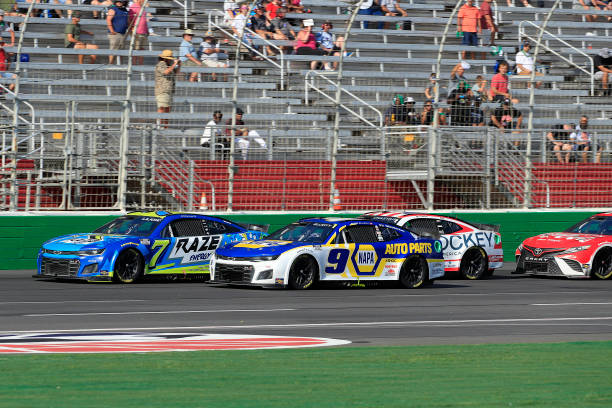
Photo by David J. Griffin/Icon Sportswire via Getty Images
But there was a small problem. LaJoie entered the race 34 points behind Brad Keselowski for 30th in points. If not for Keselowski’s 100 point penalty earlier that season, the deficit would have been 59 points. Based on the performance of the 7 team that year, even winning at Atlanta would have done little to float LaJoie into the Top-30. If LaJoie had won that race, he likely would have been left out of the playoffs. This talking point was brought up during the broadcast. The booth almost seemed resigned to the fact that LaJoie’s win would not mean securing a playoff spot, as if only picking up a Cup Series win was not worth it. What a shame. Guess what happened prior to the next season?
NASCAR’s elimination of the points requirement was the single shred of credibility left for how drivers qualify into the playoffs. Before 2023, at least NASCAR was ensuring the worst drivers on the season could not qualify for the postseason. Sure, there would be undeserving drivers who would clinch their spot via a fluke win. Now though, the flood gates have been opened. The last-place full-time driver made the playoffs last year. This year, a driver who will flirt with that 30th spot is guaranteed to make it.
Winning is Everything, Right?
Defenders of NASCAR’s current playoff format mostly point to the importance of the win. Ones who hated the most dreaded term of “a good points” day can now rejoice with the mentality of winning over everything. Winning is all that matters in today’s NASCAR. No more Matt Kenseth championships where a guy can hoist the trophy up by winning a single race. In today’s NASCAR, winning races is the only way to win championships. All you have to do is ignore the fundamental setup of the playoff format that would actually allow that easier than the season-long format. Also, Matt Crafton’s 2019 Truck Series Championship.
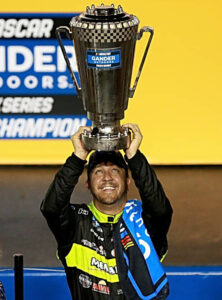
Photo by Sean Gardner/Getty Images
Although it has yet to happen in the Cup Series, NASCAR has already faced the worst case scenario in their idolized format. Matt Crafton went winless throughout the entire 2019 Truck Series season. Somehow though, he managed to advance to the Championship Four and win the whole thing while finishing second. The other three Championship Four competitors had a combined 9 wins. Austin Hill, the driver who won the finale, also had 4 wins. Instead of awarding winning that season, the Truck Series champion was a driver with only 2 second place finishes.
You could downplay that as whacky Truck Series shenanigans but it almost happened in the Cup Series as well. The first year this format was introduced, Ryan Newman almost stole the championship by going winless on the season. Newman finished second at Homestead in the finale, only losing to champion Kevin Harvick by a single spot.
A Fair Counterargument
During the post-Shane van Gisbergen win outrage, a fair counterpoint was made by Brett Griffin.
Winning a Cup race is hard AF to pull off.
Dominating one is even harder.
SVG dominated and won and 1000% deserves to be in the playoff over someone 16th in points. Stop crying. There’s plenty of legitimate things to bitch about. 😘
— Brett Griffin (@SpotterBrett) June 16, 2025
While there are plenty of ways to undercut the statement above (and that will happen later), let’s start by examining what should be the core takeaway from the statement. For the fans complaining about van Gisbergen having a chance at the championship, why should the driver in 16th in points have that shot anyway?
Looking at the current standings, the gap between the points leader (William Byron) and 16th is 274 points. Meanwhile, the distance between 16th (Michael McDowell) and last is only 229. Shane van Gisbergen currently sits 30th in points, only 88 points behind McDowell. What has the better chance of happening: McDowell catching William Byron or van Gisbergen pointing his way to 16th? Obviously, SVG getting to 16th in points. If that is the case, why is it so ludicrous that van Gisbergen winning a race gets him into the playoffs over a winless Michael McDowell?
When considering it from that perspective, then the win-and-in format is not the worst thing in the world. If Shane van Gisbergen is only a handful of strong races away from sitting near the Top-20 in points, then all of this outrage was for nothing.
The Value of a Win vs. Consistency
A fundamental thought when it comes to this topic is how much stock do you put into a win. Under the current NASCAR regime, a single win is more valuable than stringing together 10 straight Top-10s. Today’s NASCAR will reward the driver who wins a random race but cannot get out of their own way every other one more than a steady driver who seldomly finishes outside the Top-20.
Winning should be what (almost) every team strides for every race weekend. You do not want numerous teams being content to simply show up and “run well”. While that can be every team’s goal, the simple reality of motorsports is that every team does not have a chance to win every race. This is not a point about levels of equipment either. During any given race, there are too many factors at play that could effectively end a team’s chance at the win. It never is truly over until it is over, but sometimes the fat lady sings early for certain teams.
On top of that, you do not want every team, driver, and crew chief playing each weekend like it is a do-or-die circumstance to get a win. In theory, that sounds great. However, the reality would be more bleak. More races would turn into the ugliness from COTA in 2023 or this year’s Xfinity Martinsville finish than thrilling battles like this year’s Michigan. That is why valuing consistency should remain important. When a team cannot win a race, getting the best possible finish is the logical next goal. However, the current format would rather reward the driver who makes an impossible block that would wreck himself and the field than the one who accepts a Top-5.
Theoretically, a playoff driver should have won a race at some point. However, a 16 driver playoff field essentially guarantees that non-winners will make it. The closest the Cup Series has arrived to a full field of winners was 2022. If Kurt Busch had not been concussed at Pocono, then it would have been a full playoff field of winners. Meanwhile, Ryan Blaney (who sat third in points) would have missed. Would Austin Dillon been more deserving of a playoff spot than Ryan Blaney? Was he more deserving because he won the rain influenced Daytona race over 6th in points Martin Truex Jr? If there is a line where that answer changes, what is it? Top-10 in points? Within 200 points of the leader?
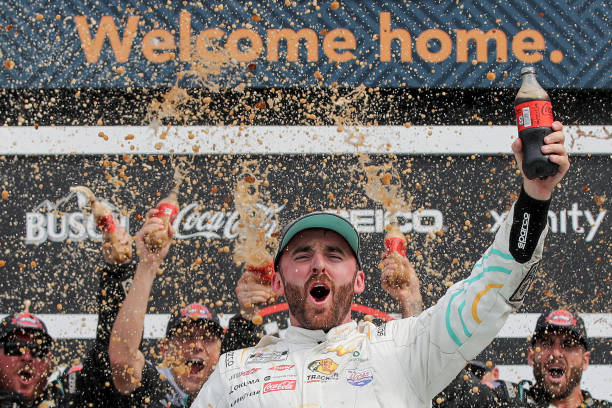
Photo by Meg Oliphant/Getty Images
More than a Playoff Spot
While there are other ways to undercut Brent Griffin’s argument, one to focus on is the greater implications of that playoff spot. Being in the playoffs is a big deal for the team, driver, and sponsors. Not only for the competitive side, but also more screentime that might not have been there otherwise. However, that pales in comparison to the financial impact of making the playoffs.
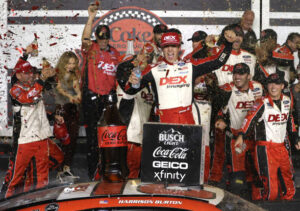
Photo by Michael Bush/Icon Sportswire via Getty Images
For whatever reason, NASCAR has not set up this format to shuffle playoff drivers back to where they would be in points once they are eliminated. Instead, the worst a playoff driver can finish in the points is 16th. Where a driver and (more importantly) a team finishes in the points ties to the end of year payout. When Harrison Burton won last year’s Coke Zero Sugar 400, the 21 team went from 34th in owner points to at worst 16th. In terms of money, that jump was worth millions.
When a team’s financial payout is severely altered by NASCAR’s playoff format, that is a strand too far. The award for an endurance of a 36 race season should not be whimsically wiped away because a road course ringer won at his one track specialty or a driver survived to win at a superspeedway. This is definitively where consistency over 36 races is more important than winning a race or two. That is why the driver/team who sits 13th in the standings should get in over the one who is in/near the 30s.
NASCAR’s Fundamental Misunderstanding
What is the point of NASCAR’s playoff format? Entertainment. You can point to Matt Kenseth’s 2003 championship or Jimmie Johnson’s domination in The Chase format as to competitive reasons for it. However, the primary reason for the playoffs is ratings. In every other major American sport, playoffs draw more eyes than the regular season. NASCAR attempted to follow this trend, especially considering disappointing numbers for later races in the season.
Surely, NASCAR and their broadcast partners believe this is working. If it was not, then NASCAR would be pressured to change it. Despite that, NASCAR’s playoff format underscores their fundamental misunderstanding of their sport and fan base.
NASCAR grew in popularity during the 1990s and early 2000s by being unique. No other notable racing series or stick-and-ball sport could offer what NASCAR did. Every weekend saw 43 drivers willingly endure harsh conditions at a variety of tracks to attempt to win a battle. The championship was a prize for the overall season, but each race felt important. Sure, there were clunkers and snores mixed in. Sometimes the championship would be decided with a race or two to spare. But that is where the misunderstanding comes in. The fans NASCAR is hoping to allure with their playoff format are not the fans who care about the championship.
Chasing the Casual the Wrong Way

Photo by Kevin Abele/Icon Sportswire via Getty Images
NASCAR’s playoff format is designed to draw the audience of the casual fan. Creating this elimination style, win-and-in set up to determine the champion is banking on peaking the interest of someone who does not watch every week. Yet, the fans who care about the championship the most are the devoted fans.
Even with the playoff format, the nature of the a NASCAR championship requires long-term commitment. Unlike the stick-and-ball sports, the playoffs still have required learning for anyone watching. For example, there are now 4 different types of points awarded each race: points for finishing result, stage points, playoff points, and the fastest lap point. How exactly is the casual or first time fan supposed to follow that? As currently presented, NASCAR’s playoff format is not friendly to someone who does not watch on a consistent basis.
If NASCAR wants to chase the casual fan, doing a gimmicked and convoluted points format to crown a champion is not the way. Which race receives the most viewers on a really basis? The season opener that has little implications on the championship. Why is the Daytona 500 the most watched race on the NASCAR calendar? Because it is the race that receives the most spectacle. It feels more important than any other race without any playoff talk required. While stage racing is there, all that matters in that race is who takes the checkered flag. That is easy to digest for a casual fan.
Build Every Race Up
Obviously, every race cannot be presented with the same pomp and circumstance as the Daytona 500. Afterall, it is the “Super Bowl” of NASCAR. However, making every race feel must watch should be what NASCAR aims to do. What NASCAR thinks will accomplish that is this win-and-in format. However, the opposite might be true. Why watch every week if nothing truly matters until the final 10 races? If you have a favorite driver, what is the motivation to watch weekly if they win a race early? Despite NASCAR screaming at the fans that every race matters with this format, that is not the truth. Now, only certain races matter to certain fans.
When you review the ratings from the past 2 years, what you will see are the special races are the ones that receive the most eyes. After the Daytona 500 boom period ends, the highest rated races are Talladega, summer Daytona, and the signature events. Last year, the return of the Brickyard 400 and the Chicago Street Race drew more than any other race after the first Talladega. Races that feel special will usually receive the better ratings. Once again, not every race can be a spectacle like Chicago or the Brickyard. However, NASCAR could be doing better at making every race feel must-watch. Back in the day, they were able to do that without a win-and-in system for a playoff.
With NASCAR’s playoff format, one would think that the Championship Race would see improved ratings. However, that has not been the case. While the Championship Race does marginally better compared to the rest of the season, it does not provide the boost that other sport leagues’ championship games or series see. Most notably, the 2022 Championship Race failed to spark a drastic increase to the ratings. That was after Ross Chastain’s Hail Melon broke the internet. The most viral moment in NASCAR’s recent history barely made a dent in carryover into people watching the championship. If that does not speak volumes to how flawed the system is, then what other signs does NASCAR and their partners need?
“Game 7” Moments
Once again, NASCAR’s playoff format fails to recognize a key element to what it is trying to do. NASCAR is attempting to host that “Game 7” moment every year, multiple times a year. Exactly 5 times per season, the intense drama of a do-or-die situation is manufactured for fans: the regular season finale, 3 elimination races, and the championship race. Every season, NASCAR provides fans with these 5 “Game 7” moments. With every year that passes, the more those moments feel diminished.
Why do fans enjoy “Game 7” moments? While the drama from those moments/games are great sports entertainment, the key element is the rarity. Not many series go to a Game 7, which already makes it feel special. Plus, not every Game 7 is a close competition. When the circumstances allow for those spectacular moments to happen, that is what makes it special. For a league to arbitrarily set up these moments on a yearly basis, it loses all value. When every season has those special “Game 7” moments, it diminishes the value of what those moments should be.
The cold reality of running a sports league is the necessity of the boring and mundane. Accepting that in competition a team or athlete can have it figured out better than the rest and dominate their competitors. Actually, numbers indicate that a dominate figure in a sport helps boost ratings. Chasing parity is a bit of fool’s errand, especially if it feels artificial. In NASCAR, people might point to declining ratings during Jimmie Johnson’s reign of terror. Part of that was due to Johnson’s domination. However, a large chunk of that vanishing fanbase was leaving due to the gimmicked nature of Johnson’s championships. Chad Knaus and Jimmie Johnson had the system figured out and rigged it for themselves in a way that no other team. It was certainly greatness, but not in the same way others had dominated the sport.
If NASCAR feels the need to have a playoff format, go back to The Chase. With limited testing nowadays mixed with parity of the Gen7, it would be difficult to see a team exploit the system the way the 48 did. At least under The Chase format, 10 races determined the champion rather than 3-4 (as seen last year). There will be some boring championship battles, but the flip side will be exciting ones that have more impact than any Championship Race will ever.